11.3 Tutorial feedback
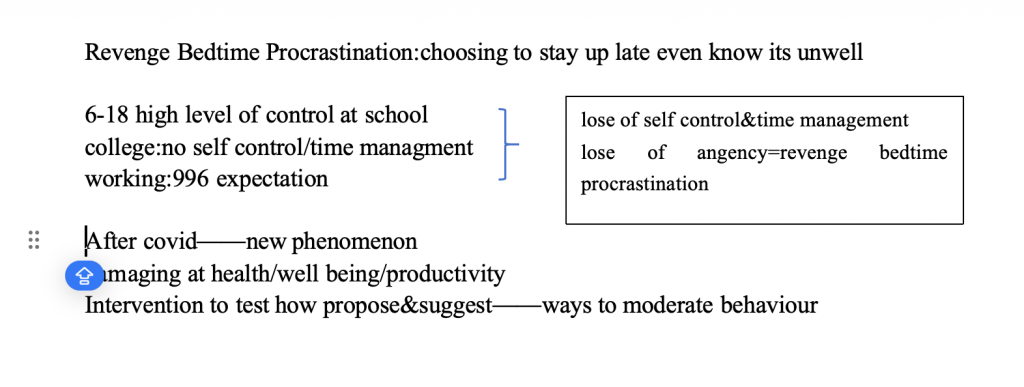
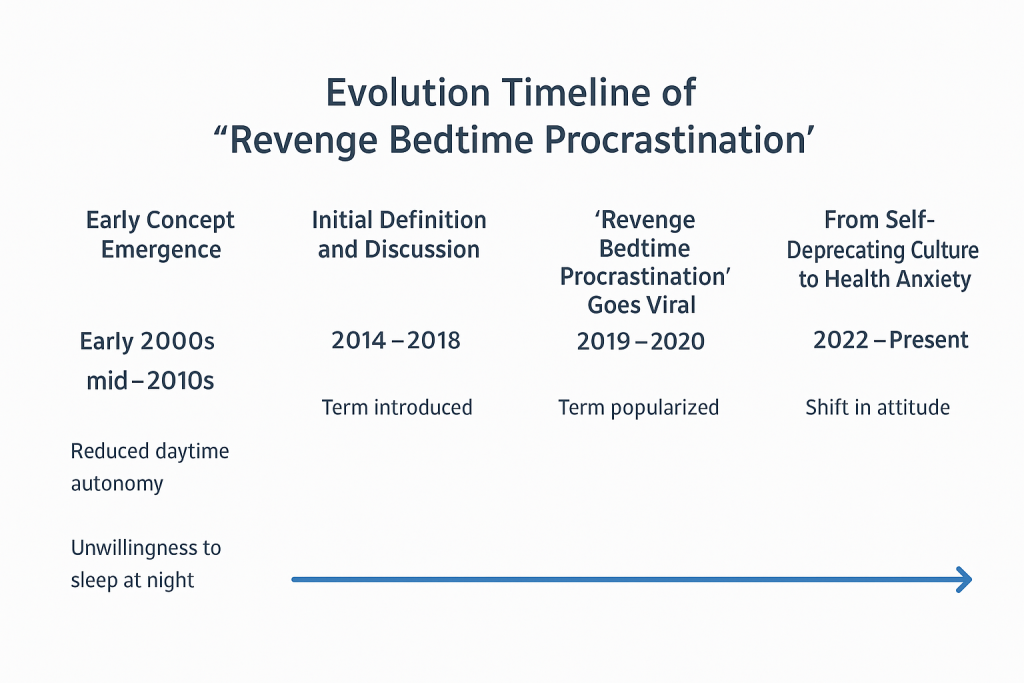
The emergence and popularization of Revenge Bedtime Procrastination is a gradually evolving process.From the 2000s to the mid-2010s, the concept was not yet fully formed, but there was already basic research on “bedtime procrastination” and “nighttime is the only free time”. The concept of bedtime procrastination was first proposed in 2014(Kroese et al., 2014).Between 2019 and 2020, the phrase Revenge Bedtime Procrastination went viral on social media, becoming a widely shared cultural phenomenon,especially during the COVID-19 (Ramaswamy, C., 2020).By 2022, public attitudes began shifting away from glorifying late-night habits toward greater concern for sleep health, emotional wellbeing, and time pressure. (White Paper on Sleep Health, 2024).
·KeeSleep., n.d. 研究发现:92.6%的大学生有熬夜习惯. Available at: https://www.keesleep.com/news/info/290.html
·Kroese, F.M., de Ridder, D.T.D., Evers, C. and Adriaanse, M.A., 2014. Bedtime procrastination: Introducing a new area of procrastination. Frontiers in Psychology, 5, p.611. https://doi.org/10.3389/fpsyg.2014.00611
·Ramaswamy, C., 2020. The psychology behind revenge bedtime procrastination. BBC Worklife. Available at: https://www.bbc.co.uk/worklife/article/20201123-the-psychology-behind-revenge-bedtime-procrastination
11.4 seminar reflection
Plan(direction)
Secondary research
Define plan
Test(intervention)
Analysis
Reflection——Value(communicate、create、identify、range of audiences)
Value——You(experience、values、cultural context)
Reflection:
1.learn from personal experience to understand the value process——wiser choice
2.critical reflection is how we review our past events and they reveal to us how we see the world——see how you see the world
3.Relationship between your insights and actions,identify opportunity,remaining engage
4.Action research——knowing in action,knowledge gained through the interaction of your action in the process
5.Find value in each point——how to cummunicate
6.Its not experience,but our interperation and understanding that leads to knowledge.
4i Reflection
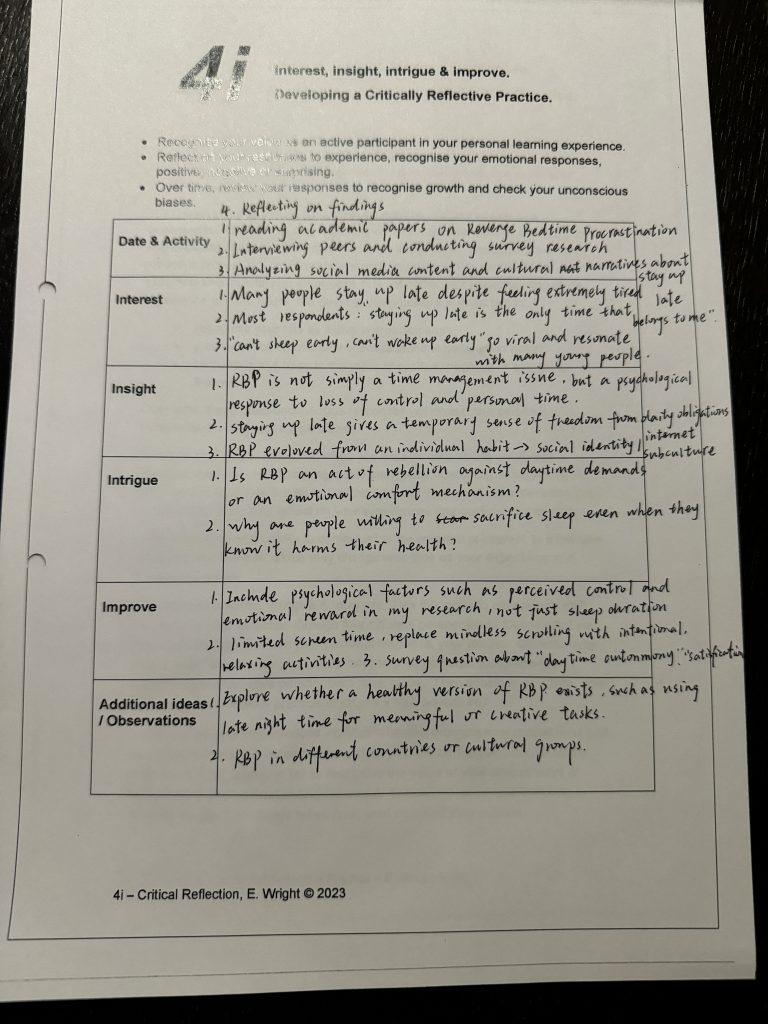
Based 4i:
Why I Started This Research
Like many people, I found myself staying up long after I was tired. Even on days filled with responsibilities, the quiet hours of the night felt like the only time I could truly call my own. This personal experience made me realise: Revenge Bedtime Procrastinationisn’t just “not wanting to sleep.” It reflects something bigger ,how our days are structured, how our emotions accumulate and how we protect autonomy.This realisation became the foundation of my research question.
What I Explored
To understand this behaviour holistically, I designed four interventions:
Sleep Transfer Experiment
→ Could the satisfaction of “mytime” at night be moved to the daytime?
Daily Rhythm Perception
→ How do daily rhythms and emotional depletion build up the urge to stay up late?
Self-Control Schedule
→ Can increasing daytime autonomy reduce late-night compensation?
Time-Perception Manipulation
→ Does the satisfaction come from night-time itself or simply from a sense of time ownership?
What I Learned
1. Autonomy during the day matters
Simply adding free time isn’t enough. The key is meaningful autonomy — activities that feel genuinely self-chosen.
2. Night-time holds symbolic weight
For some people, the night represents calm, identity, emotional safety or self-ownership. These deeper meanings cannot be replaced by daytime breaks.
The project revealed two types of Revenge Bedtime Procrastination:
Substitution-possible type
Night-dependent type
This means that future solutions must be personalised, not universal.
How This Project Changed Me
This research profoundly influenced how I think as a designer and researcher:
I now look beyond the surface of behaviour to uncover the hidden logic behind it.
I learned to design not just outcomes, but processes, methods and interventions.
I developed a more systemic, analytical and human-centred mindset.
Working across psychology, design and behavioural research strengthened my ability to collaborate across disciplines.Most importantly, I now see how design can meaningfully engage with emotional wellbeing, daily routines and our relationship with time.
Where This Work Could Go Next
Designing tools that help people recognise their daily emotional rhythms、Developing personalised solutions for different type、 Exploring how workplaces and schools can build healthier temporal structures、Continuing research on digital habits, autonomy and emotional recovery.
Revenge Bedtime Procrastination is not just a sleep issue; it reflects how we live, work, feel and cope. By understanding it deeply, I learned more about people and about myself. This journey reminded me that meaningful design starts with empathy, curiosity and the courage to question the ordinary behaviours we take for granted.
Leave a Reply