Reflections on the Seminar:
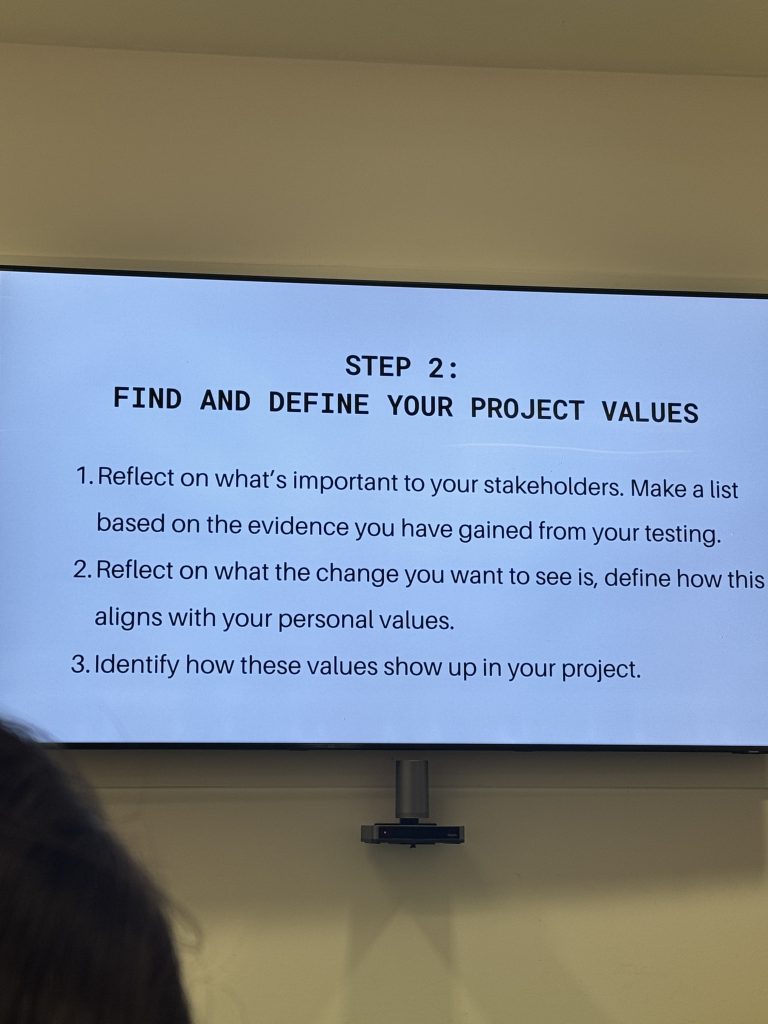
Find and Define Your Project Values
1. What’s important to your stakeholders?
My main stakeholders include young professionals and university students.
They value:
Improving sleep quality and mental well-being;Enhancing daytime productivity and sense of time control;Finding practical and achievable self-regulation strategies;Developing a sustainable daily rhythm through behavioral interventions.
2. What change do you want to see, and how does this align with your personal values?
I hope this project can help young people break the vicious cycle of revenge bedtime procrastination, enabling them to gain a stronger sense of control and fulfillment during the day.
3. How do these values show up in your project?
The research methods emphasize self-reflection and sustainable practice.
Each intervention experiment (such as the Rhythm Tracking Card and Self-Control Plan Sheet) embodies the values of respecting individual differences and understanding behavioral motivations.
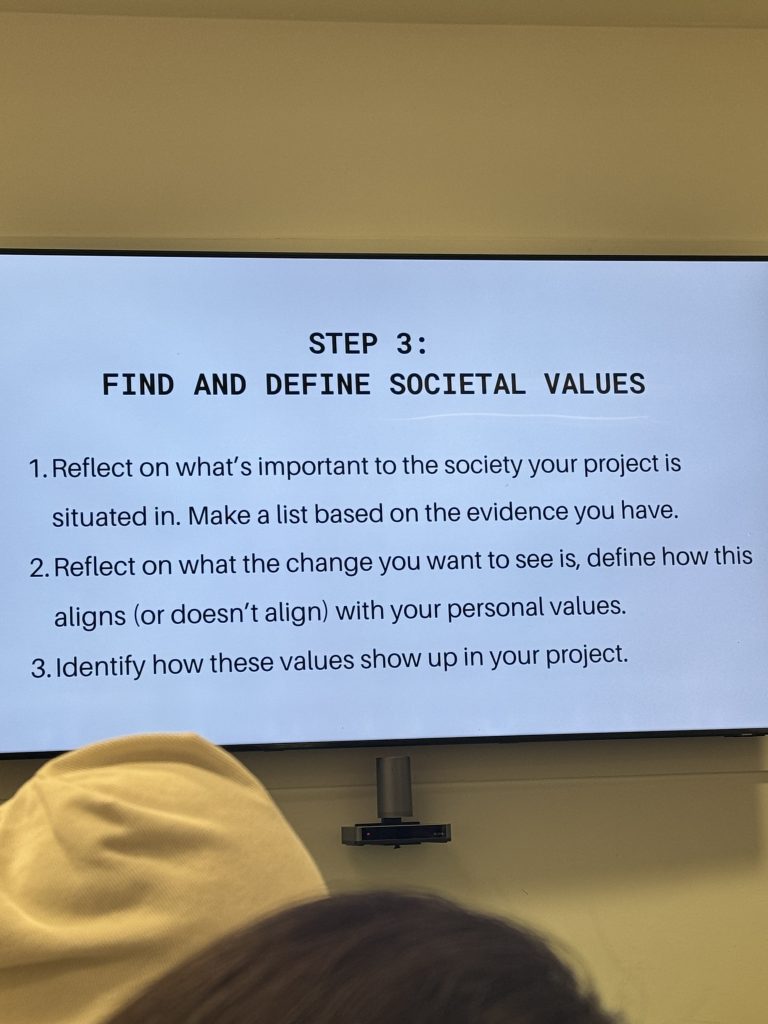
Find and Define Societal Values
1. What’s important to the society your project is situated in?
Modern society is characterized by widespread time anxiety, overwork culture, and digital dependence—and revenge bedtime procrastination has become a concentrated reflection of these issues.
Societal concerns include:How to maintain mental well-being amid high pressure and information overload;How to balance work and personal life.
2. What change do you want to see, and how does this align (or not) with your personal values?
I hope to make mental health an integrated part of everyday life, rather than a remedy only sought during moments of crisis.
3. How do these values show up in your project?
The experimental design serves not only individual needs but also responds to broader public health and social well-being issues.The project has strong social communication potential—it can raise public awareness of mental health through event design, public exhibitions, and interactive experiences.
Generational and Social Perspective——Interview
Reasons for Interviewing a Different Demographic Group (Older Generation)
1. Generational Comparison
Through interviews with the older generation, it becomes possible to identify differences across eras in attitudes toward daily routines, life pace, social pressure, and leisure activities.
In the past, life was slower and digital entertainment was scarce — staying up late was usually for work or special circumstances.In contrast, modern young people tend to stay up late due to psychological compensation, the pursuit of freedom, and digital dependence.
This generational difference helps reveal that Revenge Bedtime Procrastination is not merely a physiological issue, but a psychological phenomenon shaped by cultural and societal transformation.
2. Cultural and Structural Insight
The life experiences of older participants reflect broader changes in social systems, temporal rhythms, and value orientations.They have lived through an era that emphasized “early to bed and early to rise” and a culture of diligence, whereas today’s world is characterized by fragmented time, digital saturation, and high pressure.
Comparing these two temporal structures helps expose the social roots underlying revenge bedtime procrastination.
3. Intergenerational Understanding
Such interviews not only help the researcher understand how older generations perceive the younger generation’s sleep patterns, but also build a bridge for empathy and mutual understanding between generations.
This dialogue helps challenge stereotypes — such as viewing young people as “lazy” or assuming older people “don’t understand” — fostering deeper reflection on intergenerational perceptions of time, rest, and autonomy.
Contribution to My Research
1. Broader Social Dimension
Focusing only on young people could make the research conclusions limited to the individual level, lacking a wider social context.Interviews with older adults provide a socio-cultural reference point, helping to explain the generational evolution and societal roots of late-night behavior.
2. Theoretical Validation
By comparing the motivations for staying up late among different age groups, the study can test whether the concept of autonomy deficit is universally applicable.
If older participants also express similar motivations — such as seeking freedom or compensatory satisfaction — it suggests the theory has broad explanatory power.
If the differences are significant, it highlights modern environmental factors (e.g., digitalization, social pressure) as key variables influencing the phenomenon.
Reflection
1. Re-examining the Social Distribution of “Free Time”
Intergenerational dialogue encourages reflection on the scarcity and inequality of free time in modern society.
Young people’s “revenge” behaviors at night actually reveal a deeper issue — the loss and compression of personal time within structured daytime systems.
2. Promoting a Societal Discussion on Healthy Rhythms
The findings can contribute not only to individual mental well-being but also to a broader social conversation about cultivating a healthy time culture:
How can work structures become more humane?How can individuals rebuild a sense of rhythm and balance in an age of constant digital stimulation?
The identity and background of the interviewees:
Interviewee 1:Born in 1975and living in China, she is a financial analyst.
Interviewee 2:Born in 1975 and living in China,she is a doctor.
Interviewee 3:Born in 1973 and living in China,she is a teacher.
Interviewee 4:Born in 1970 and living in China,she has retired now.
Interviewee 5:Born in 1970 and living in China, he is a policeman.
Interviewee 6:Born in 1978 and now lives in the United States,she is an accountant.
Section 1: Basic Awareness and Attitudes
Q1: Have you heard of the term “Revenge Bedtime Procrastination”? How do you understand it?
Interviewee 1: Has not heard of it. Thinks it means excessive staying up late. Believes the word “revenge” is not accurate—people might simply want to stay up. Suggests dividing the group into two types: those with pressure and those without; staying up late relates to daytime activities.
Interviewee 2: Has not heard of it. Believes it means using the nighttime to do what one wants—a kind of unrestricted behavior that sacrifices sleep.
Interviewee 3: Has heard of it. Does not approve of it but believes it’s inevitable.
Interviewee 4: Has heard of it but doesn’t fully understand it. Thinks the term is unscientific and prefers to see it as a “respect for the soul.” Staying up late, though harmful physically, gives life more “depth than length.” If it brings value, it is not harmful.
Interviewee 5: Has not heard of it. Thinks the nighttime is a time for emotional release.
Interviewee 6: Has not heard of it. Although not familiar personally, believes it is a phenomenon worth improving.
Q2: What do you think are the main reasons young people stay up late?
Interviewee 1: Too much temptation from social media and smartphones.
Interviewee 2: For work or study; heavy pressure and unfinished tasks; too many entertainment options lead to indulgence.
Interviewee 3: The internet provides opportunities to stay up; daytime pressure and lack of free time force people to use the night.
Interviewee 4: Busy life and little personal time; staying up late becomes a way to seek joy and release pressure; needs a balance between body and mind.
Interviewee 5: Heavy mental stress with no outlet; too much social interaction during the day, so the night becomes private time.
Interviewee 6: Academic and job competition is intense; personal time is occupied—people seek short-term happiness.
Q3: Do you think staying up late is a “passive act” or an “active choice”? Why?
Interviewee 1: An active choice—using the phone or entertainment leads to staying up.
Interviewee 2: Both; some actively stay up to finish tasks.
Interviewee 3: Active—nighttime offers greater freedom.
Interviewee 4: Both; nighttime cannot be replaced.
Interviewee 5: Passive—no one truly wants to stay up late.
Interviewee 6: Active, but influenced by limited personal space and external factors.
Q4: Do you think young people stay up late more for entertainment or because of daytime stress?
Interviewee 1: Mostly for entertainment; believes young people are not under great pressure.
Interviewee 2: Both.
Interviewee 3: For entertainment—to freely do what they want at night.
Interviewee 4: Both.
Interviewee 5: Half and half.
Interviewee 6: Both—pressure leads to the need for relaxation.
Section 2: Generational and Social Perspective
Q1: When you were younger, did people also stay up late? What were the reasons then?
Interviewee 1: No; had to work the next day.
Interviewee 2: Yes, sometimes for work tasks or stimulating entertainment.
Interviewee 3: Rarely; there was no social media or late-night entertainment environment.
Interviewee 4: No; lack of digital devices and social context.
Interviewee 5: Very rarely.
Interviewee 6: No such behavior.
Q2: How do modern work rhythms and digital media affect young people’s sleep habits?
Interviewee 1: Digital media has a strong influence.
Interviewee 2: Social and family pressures are high; the internet causes people to lose a sense of time order.
Interviewee 3: Provides motivation and temptation to stay up.
Interviewee 4: Delays bedtime and causes late-night habits.
Interviewee 5: Work pace limits daytime freedom, pushing young people to use the night.
Interviewee 6: Offers a channel for revenge bedtime procrastination; if society took it seriously, the problem might ease.
Section 3: Emotional and Psychological Understanding
Q1: Do you think people stay up late as a way to “take revenge” on lost daytime time?
Interviewee 1: No, it’s purely for entertainment and relaxation.
Interviewee 2: Not necessarily; there are many reasons.
Interviewee 3: Not exactly revenge—too many choices make people feel short of time.
Interviewee 4: Yes, it’s a way of emotional release.
Interviewee 5: Yes, because there’s no autonomy during the day.
Interviewee 6: Yes, because daytime personal time is limited.
Q2: Have you ever stayed up late yourself to have “personal time”?
Interviewee 1: Yes.
Interviewee 2: Yes—to read or learn new skills; nighttime feels more controllable.
Interviewee 3: Yes—too many distractions during the day; nighttime is freer.
Interviewee 4: Often.
Interviewee 5: Yes.
Interviewee 6: Not before, but now yes; partly forced, partly voluntary for social reasons.
Q3: If your child often stays up late, do you see it as laziness or a need to be understood?
Interviewee 1: Depends on what they do during the day—if busy, not laziness.
Interviewee 2: Understandable if for work or study, but not if addicted to the internet; parents should guide.
Interviewee 3: Understandable.
Interviewee 4: Sympathetic but conflicted; would remind gently but respect autonomy.
Interviewee 5: Needs understanding; daytime stress and fatigue make phone use a way to relax and think.
Interviewee 6: Doesn’t fully understand but would advise from a health perspective.
Section 4: Coping and Reflection
Q1: What could help young people reduce the habit of staying up late?
Interviewee 1: Set a regular schedule and make daytime more fulfilling.
Interviewee 2: Better time management, efficiency in work/study, and self-control over media use.
Interviewee 3: Exercise and social activities.
Interviewee 4: Strict control combined with care.
Interviewee 5: More communication and outdoor activities.
Interviewee 6: Exercise—self-motivation is key.
Q2: How can families, workplaces, or society create a healthier time rhythm for young people?
Interviewee 1: Raise awareness through positive social campaigns and education.
Interviewee 2: Encourage learning and self-development; avoid digital overuse. Purposeful staying up can be healthier than passive indulgence.
Interviewee 3: Limited job opportunities and rigid systems make the issue worse—difficult to change.
Interviewee 4: Parents should model and support healthy sleep routines.
Interviewee 5: Encourage physical activity to relieve stress.
Interviewee 6: Offer meaningful social, creative, and leisure activities to enrich life.
Interview analysis and summary
1. Understanding of the Concept “Revenge Bedtime Procrastination”
Most interviewees had not heard of the term “Revenge Bedtime Procrastination.” Some believed that the word “revenge” carries a negative emotional tone and does not fully capture people’s real motivations for staying up late (Interviewee 1). Others viewed staying up late as a form of emotional release or a way to respect one’s inner self — even as something that gives life “depth” rather than mere “length” (Interviewees 4 and 5). Some also acknowledged that the phenomenon deserves attention, as long-term sleep deprivation can indeed harm physical health (Interviewee 6).
Analysis:
The older generation tends to interpret the behavior from the perspective of life experience and personal values, seeing it less as an act of “rebellion” or “revenge” and more as an expression of emotional needs and lifestyle rhythm.
2. Understanding of Why Young People Stay Up Late
All interviewees mentioned a combination of external social factors and internal psychological needs. The stimulation from social media and digital entertainment serves as a major external driver,while the lack of personal time during the day,occupied by work or study,makes the night a space for psychological compensation and self-regain of control.
Analysis:
The older participants generally believed that the root cause of young people’s late-night habits lies in time imbalance and the deprivation of personal autonomy. Staying up late thus becomes a way to compensate psychologically and reclaim control over one’s time.
3. Active Choice or Passive Helplessness?
Some interviewees saw staying up late as an active choice,young people willingly sacrifice sleep for freedom and enjoyment (Interviewees 1, 3, 6). Others viewed it as a passive behavior, driven by external pressures such as work demands, unfinished tasks, or social expectations (Interviewees 2, 4, 5).
Analysis:
This duality reveals the paradoxical nature of revenge bedtime procrastination,it represents both a form of self-assertion and a symptom of structural constraint. In other words, it embodies a kind of “passive agency”, where individuals seek autonomy within restricted conditions.
4. Generational Differences and Socio-Cultural Context
When recalling their youth, most interviewees reported that staying up late was rare, largely because the social rhythm was slower, digital entertainment was limited, and work and rest schedules were more regular.
They agreed that today’s fast-paced society, increased work pressure, and fragmented digital lifestyle have made the night the only controllable time for many young people.
Analysis:
This comparison highlights that the phenomenon is not a matter of individual self-discipline, but rather a product of social acceleration and cultural transformation. Revenge bedtime procrastination reflects how modern life restructures our relationship with time and autonomy.
5. Emotional and Psychological Understanding
The older participants generally expressed understanding and empathy toward young people’s staying-up behavior. While they did not entirely approve of it, they recognized the underlying emotional and psychological motives
Analysis:
This intergenerational empathy suggests that the needs for temporal autonomy and psychological compensation are universal human experiences, not limited to any single age group.
Summary:
Generational Comparison——Demonstrates that Revenge Bedtime Procrastination is a product of changing social rhythms and cultural contexts, rather than a universal human tendency.
Autonomy Deficit——The older generation’s understanding of the lack of autonomy supports the theory’s relevance and explanatory power.
Cultural Insight——Reveals the deeper links between modern social pace, digital dependence, and time-related anxiety
Design Implication——Provides direction for research-driven design: using experiential activities, rhythm-based interventions, or public engagement to address the social roots of Revenge Bedtime Procrastination.
Participation and Evidence:
Interview audio recording
The interviewee mentioned that she had never heard the term “revenge bedtime procrastination” before, but after hearing the explanation, she found it very accurate and meaningful.
She believes that staying up late is a negative habit worth reflecting on and changing, as it can have direct harmful effects on health—especially for people her age as well as the younger generation.
In her opinion, the main reasons young people stay up late include:
Work and study pressure—many people have little personal time during the day and use late nights as a way to relax and reclaim that time.
Lack of awareness about health—some people stay up simply for short-term pleasure without considering long-term consequences.
She pointed out that staying up late can be both voluntary and involuntary: it is often a personal choice, but also a result of modern life and limited personal space.
When she was younger, people rarely stayed up late, since life and study schedules were more disciplined and regular.
She emphasized that modern technology and social media contribute greatly to the problem, as they make it much easier for people to stay awake with endless digital entertainment.
Psychologically, she believes that those who engage in revenge bedtime procrastination are not just staying up for fun, but rather trying to make up for the personal time they lose during the day.
Speaking about her own experience, she said she didn’t use to stay up late, but now sometimes does so for social reasons, like playing mahjong. While it can feel somewhat passive, she acknowledges that it is still a personal choice of social activity.
Regarding young people, she believes their behavior should not be excused, but instead guided with concern for their health. She suggests that improving this habit requires:
More physical exercise;Self-discipline and a healthier sleep schedule;Understanding that good rest improves both productivity and well-being.
The interviewee explained that she had not heard the term “revenge bedtime procrastination” before, but she immediately understood its meaning after hearing the explanation.In her view, it describes a situation where people—both young and middle-aged—seek emotional release at night, when everything is quiet and they can finally relax after a busy day.
She believes that the main reason young people stay up late is psychological pressure.Many people experience high stress during the day and lack meaningful communication with others.
As a result, nighttime becomes their only chance to unwind and express their emotions—often by scrolling on their phones or watching videos.
In her opinion, staying up late is mostly passive rather than intentional.
No one truly wants to stay up late; instead, it happens because of work demands, stress, or emotional needs.
She thinks that for many young people, it’s half about entertainment and half about stress relief—some do it for fun, while others use it as an outlet after exhausting days.
Reflecting on her own youth, she said she rarely stayed up past midnight, usually going to bed around 10 or 11 p.m.However, she noted that modern society and social media have worsened the problem, since people are constantly exposed to digital content that keeps them awake.
She observed that many people only find time for personal interests or self-learning at night, which pushes them further into this late-night routine.
She believes that people who engage in revenge bedtime procrastination are compensating for the lack of personal freedom during the day—they finally get to do things for themselves, like shopping, watching shows, or reading.
In her own life, she admits that she sometimes chooses to stay up late to enjoy her own time, such as listening to audiobooks, watching dramas, or browsing online stores.
When asked about her attitude toward her children staying up late, she said this behavior should not be dismissed as laziness.
Rather, it deserves some understanding, because many young people are mentally tired after busy days and use their phones as a way to relax and process their thoughts.
For some, late-night scrolling even helps them reflect and regain a sense of direction.
The interviewee said that she had heard the term “revenge bedtime procrastination” before, but she did not fully agree with it. In her opinion, the phrase is not entirely scientific, because what people often call “revenge” staying up late can sometimes be understood as “respecting the soul.”
She explained that while staying up late may harm the body, it can also be a way to honor one’s inner self. For her, nighttime represents freedom of the mind—a period when people can truly relax and feel spiritually alive.
She emphasized that life is not only about its length, but also about its depth: “Sometimes, physical rest must give way to spiritual freedom.”
Reasons Why Young People Stay Up Late
She believes there are several reasons:
Busy schedules — young people have little time during the day for themselves.
Emotional release — nighttime becomes a moment to unwind and regain lost happiness, often through short videos, social media, or other light entertainment.
Access to information — much knowledge and inspiration now come through the internet, and late-night browsing can expand one’s horizons.
Thus, she thinks that while staying up late may affect health, it also brings emotional satisfaction and intellectual gain, and the key lies in balance.
According to her, being able to manage one’s sleep–wake rhythm and balance physical needs with spiritual pleasure is a sign of maturity and inner strength.
Active or Passive Behavior
She believes that staying up late can be both passive and voluntary.
Some people are forced to do it due to work or study, but others—like herself—choose it consciously for personal enjoyment or emotional freedom.
For instance, watching a rare event like the World Cup or engaging in favorite late-night activities can bring a sense of fulfillment that cannot be replaced by sleep.
Still, she added that true wisdom lies in knowing when to stop—to rest when tired, and to enjoy wakefulness when it brings peace.
Comparison with the Past
When she was young, she said, people rarely stayed up late because the environment didn’t allow it—there were no smartphones, and electricity or entertainment options were limited.
Today’s digital media and fast-paced life encourage late nights, often pushing sleep schedules later and later.
Psychological Perspective
She believes many people stay up late to reclaim the time lost during the day—to do things they enjoy after spending all day working or studying.
Each person has a different form of joy: some play games, some dance, some shop online, others just watch videos. All of these are ways of releasing stress and finding small moments of happiness.
Personal Experience
She admitted that she herself often stays up late to enjoy personal time, such as watching shows, reading, or shopping online.
As a mother, she said that when her children stay up late, she feels conflicted—on one hand, she worries about their health; on the other, she understands that they need time to relax and think.
She believes parents should gently guide rather than control, showing care and reminding their children to rest, but ultimately allowing them to make their own choices.
The interviewee has heard of “revenge bedtime procrastination” and described it as a love–hate behavior—something she doesn’t approve of but finds hard to avoid.
She believes young people stay up late mainly because of work and study pressures that leave them little free time during the day.
At night, they finally gain personal freedom to relax, watch videos, play games, or shop online.
She sees this behavior as an active choice rather than a passive one.
Modern technology and entertainment provide too many temptations, making it easy to lose track of time.
Unlike in the past, when life was simpler, today’s abundance of digital content and leisure options encourages late-night wakefulness.
She doesn’t view it as “revenge,” but as a response to overstimulation and a desire for personal time.
She admits she sometimes stays up late herself to enjoy quiet, undisturbed moments.
If her children do the same, she said she would understand rather than criticize, seeing it as their way of seeking freedom.
To improve sleep habits, she suggests exercise, social activities, and meaningful hobbies.
She also believes society should help young people build richer, healthier lifestyles so they no longer need to find freedom only at night
The interviewee had not heard of “revenge bedtime procrastination” before, but interpreted it as staying up late to do personal tasks or enjoy free time, especially when daytime is too constrained.
He believes the main reasons young people stay up late are:
Work or study demands, often unfinished during the day.
High social and work pressure, leading to extended hours.
Abundant entertainment options, both online and offline, making it easy to lose control of time.
He sees both active and passive causes of staying up late:
Active when people choose to work or study with purpose.
Passive when people become addicted to online entertainment or lack self-control.
He admits that he sometimes stays up late himself — mainly to study or learn new skills, which he views as a planned and controlled form of staying up late.
If his children stayed up late, he would understand planned, purposeful behavior, but discourage excessive screen use or aimless scrolling.
To help young people develop healthier habits, he suggests:
Better time management and efficiency during the day
Self-discipline to resist digital distractions
Parental and social guidance to build balanced routines
He emphasizes that “active” late nights can be constructive, bringing satisfaction and growth, while “passive” late nights cause only fatigue and harm.
Society and families, he believes, should create supportive environments that encourage productivity, physical activity, and self-improvement instead of escapism
The interviewee had not heard of the term “revenge bedtime procrastination” before, and understood it simply as staying up too late or excessive sleeplessness.
She believes the main cause of late nights among young people is the temptation of smartphones and social media, which make it easy to stay up voluntarily. In her view, staying up late is an active choice, not a passive one — people choose to stay awake for entertainment, not because they are forced to.
She thinks young people mostly stay up for leisure, not due to stress, unlike earlier generations who avoided staying up because of work discipline. Modern technology, she says, encourages late nights through constant digital engagement.
In her opinion, staying up is not about “revenge” or compensating for lost time, but simply a way to kill time or seek amusement. She notes that motivations differ:
Those who work hard in the day may stay up to relax,
While those with little daytime responsibility do so out of idleness.
She admits she has occasionally stayed up late for personal time but now maintains better sleep habits due to busier days.
If her children stayed up late, she would evaluate the context — understanding it if they had a busy day, but viewing it as laziness if they stayed up without purpose.
To help young people improve sleep habits, she suggests:
Creating a daily schedule and structured routine.
Staying more active during the day to promote natural tiredness at night.
Public campaigns and media guidance to educate people on the health risks of sleep deprivation and the benefits of regular rest.
She emphasizes that society can’t control individuals’ sleep, but consistent positive messaging and personal self-discipline are key to healthier routines.
Leave a Reply